
Parent Controls for AI Toys: What Families Should Look For
When families hear about AI toys, the first reaction is often curiosity. The second reaction is usually a very practical question: how much control do parents actually have?
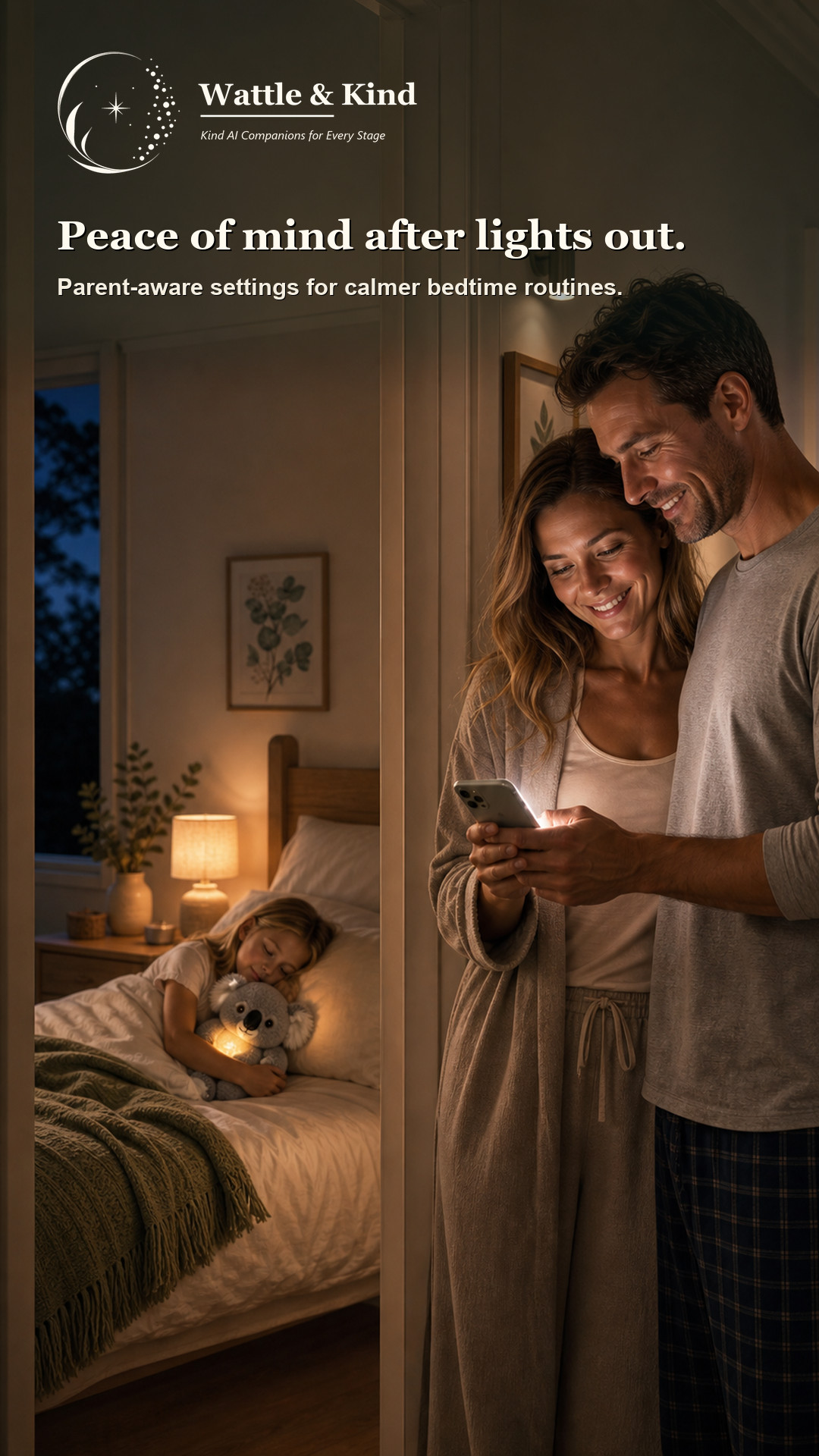
That question matters. A connected toy or AI plush companion may feel gentle and playful, but it still belongs inside a family boundary. Parents should understand what can be set, paused, reviewed, limited, or turned off.
This guide explains the kinds of parent controls families may want to look for when considering AI toys, talking toys, smart speakers, or connected plush companions.
It is not legal, safety, medical, or technical advice. It is a plain-language checklist to help families ask better questions.
Why parent controls matter
Children need products that are designed around their age, attention, emotions, and family context. Parents need tools that are easy to understand.
Good parent controls should not feel like a hidden technical menu. They should help families answer simple questions:
- When can the toy interact?
- What kind of interaction is allowed?
- Who can change settings?
- Can use be paused?
- What happens to data?
- What are the product’s limits?
The best controls are not only about restriction. They are about making the product understandable.
1. Setup should involve a parent
For child-facing connected products, setup should not feel like something a child is expected to manage alone.
Parents can ask:
- Is there a parent-led setup process?
- Does setup explain privacy and interaction clearly?
- Can a parent review settings before first use?
- Are default settings conservative?
- Does the product avoid asking children for unnecessary personal information?
If a toy is designed for family life, parents should be part of the starting point.
2. Interaction should have clear boundaries
An AI toy should not feel like an unlimited open door. Parents may want to know what kinds of topics, tones, and responses are allowed.
Useful controls may include:
- Age-aware conversation boundaries
- Topic restrictions
- Story or activity modes
- Calm-time settings
- Limits on sensitive or inappropriate topics
- Clear refusal behaviour for unsafe requests
Families should also look for plain language about what the product does not do.
3. Quiet times can help protect family routines
Some families may want a toy to support calm moments, but not interrupt meals, school mornings, homework, or bedtime.
Quiet-time controls can help parents decide when interaction is available.
Parents can ask:
- Can interaction be paused?
- Can bedtime or quiet hours be set?
- Can notifications or sounds be limited?
- Can parents quickly disable the interactive mode?
- Does the toy still feel useful as a soft plush when interaction is off?
For bedtime, less can often be more.
4. Activation should be obvious
One major concern with AI toys is whether they are always listening. Parents should understand how interaction starts.
Questions to ask:
- Is the toy always listening?
- Does it use a wake word?
- Does it use press-to-talk?
- Is there a clear light, sound, or other signal when interaction is active?
- Can listening or interaction be turned off?
For many families, press-to-talk style interaction can feel clearer because there is an obvious action that starts the conversation.
5. Privacy settings should be easy to understand
Privacy controls should not require parents to decode technical language. Families should be able to understand what information may be involved and what choices they have.
Parents can ask:
- What information is collected?
- Are voice recordings or transcripts stored?
- Is information linked to a child profile?
- Can parents review, delete, or request access to data?
- Is data used to improve the product?
- Are third-party AI providers involved?
- Is cross-border processing possible?
Clear privacy language builds trust. Vague privacy language weakens it.
6. Parents should know what cannot be controlled yet
Early-stage products may still be developing their settings, safety design, privacy flows, and app features. That is not automatically a problem if the company is honest about it.
Parents should look for brands that clearly separate:
- Current features
- Planned features
- Pilot-batch assumptions
- Things still being tested
- Things not promised yet
This is especially important for AI products, where behaviour and settings can evolve over time.
7. Controls should support, not replace, parent involvement
Parent controls are useful, but they are not a substitute for adult involvement. A connected toy should not be positioned as a babysitter, therapist, medical device, sleep solution, or guaranteed learning product unless those claims are properly supported.
Parents can ask:
- Does the brand avoid overpromising?
- Are adults still clearly responsible for supervision?
- Are product limits easy to find?
- Does the toy encourage family connection rather than replace it?
For child-facing products, trust often comes from restraint.
How Wattle & Kind is thinking about Koa
Koa is the first Wattle & Kind companion concept: a koala-inspired plush companion being shaped for screen-free stories, calm conversation, and parent-aware interaction.
Koa is still in early development. Our current direction is to build around clear activation, gentle boundaries, privacy-conscious design, and parent-aware settings. We are not presenting Koa as a finished product, a medical product, a therapist, a babysitter, or a replacement for parent connection.
Before any pilot batch, we intend to keep explaining what is confirmed, what is still being tested, and what choices parents may have.
A simple parent-control checklist
Before buying or joining an AI toy pilot, ask:
- Does setup involve a parent?
- Can interaction be paused or limited?
- Are quiet times possible?
- Is activation clear?
- Is it always listening?
- Are privacy settings explained plainly?
- Can parents review or delete information?
- Are product limits clearly stated?
- Does the company avoid overpromising?
Final thought
Parent controls should make an AI toy feel less mysterious, not more complicated.
For families, the best technology is often the kind that makes boundaries easier to understand.
Explore Wattle & Kind
If parent control is one of your main questions, you may also want to:
- Meet Koa, our first Wattle & Kind companion in early development.
- Join the Founding Families Waitlist for pilot updates and family feedback opportunities.
- Read about Privacy & Safety.
- Read the Koa FAQ.